Why New Zealand Should Choose Its Technology Allies Before a Crisis Chooses Them for Us

For most of modern history, sovereignty had a fairly simple price.
A country that wanted to remain independent needed its own armed forces, communications, intelligence capability, industrial base and institutions strong enough to protect its territory and political system.
Artificial intelligence is changing that equation.
AI is not only making offices more efficient or governments easier to administer. It is also changing warfare.
Autonomous systems, satellite networks, machine vision, cyber operations, electronic warfare, automated logistics and AI-assisted intelligence are making military power less dependent on sheer numbers of people and increasingly dependent on software, computing power, data, communications and technological ecosystems.
For a small democracy such as New Zealand, the question may therefore no longer be simply:
How many ships, aircraft or soldiers do we have?
A more important question is emerging:
Which technology ecosystem are we connected to?
A New Security Problem for Small Democracies
New Zealand benefits from geography, political stability and distance from many of the world’s traditional centres of conflict.
But distance is not the same thing as permanent safety.
Long-range autonomous systems, satellites, cyber capabilities and increasingly intelligent weapons are steadily reducing the protection once provided by oceans and geography.
That does not mean New Zealand needs to become a military superpower.
It means we need to think differently about what national security actually requires.
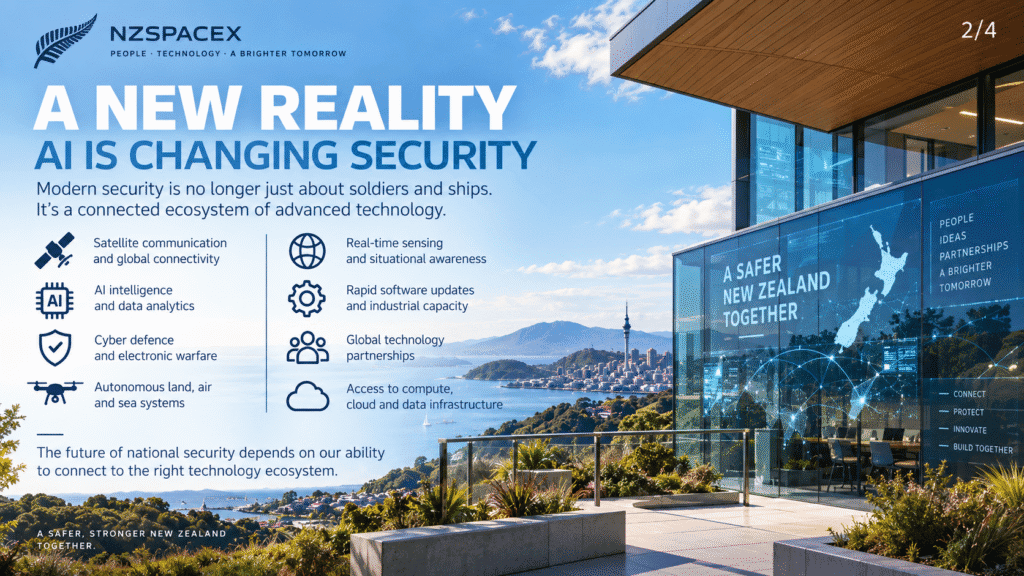
In the AI era, security is becoming less like a collection of individual weapons and more like a connected technological ecosystem.
Satellite communications. Earth observation. AI analysis. Cyber defence. Autonomous air, land and maritime systems. Cloud infrastructure. Secure data networks. Rapid software updates. Automated logistics. Industrial capacity.
The strategic asset may no longer be ownership of every individual system.
It may be reliable access to the right network of systems.
Sovereignty Does Not Mean Building Everything Ourselves
There is a common assumption that true sovereignty means owning everything domestically.
Every system.
Every platform.
Every piece of infrastructure.
But modern countries have never operated that way.
They already depend on international aviation manufacturers, global telecommunications, cloud infrastructure, software companies, semiconductor supply chains, satellite operators and commercial technology providers.
So the important question is not whether New Zealand will depend on others.
We already do.
The important questions are:
Who do we depend on?
For what?
Can those dependencies be audited, replaced and controlled?
That leads to a more practical definition of strategic autonomy:
Strategic autonomy is the ability to choose your dependencies while you still have a choice.
The Number of Real Choices May Be Smaller Than We Think
There are thousands of technology companies in the world.
There are telecommunications firms, software companies, defence contractors, cloud providers, sensor manufacturers and aerospace companies.
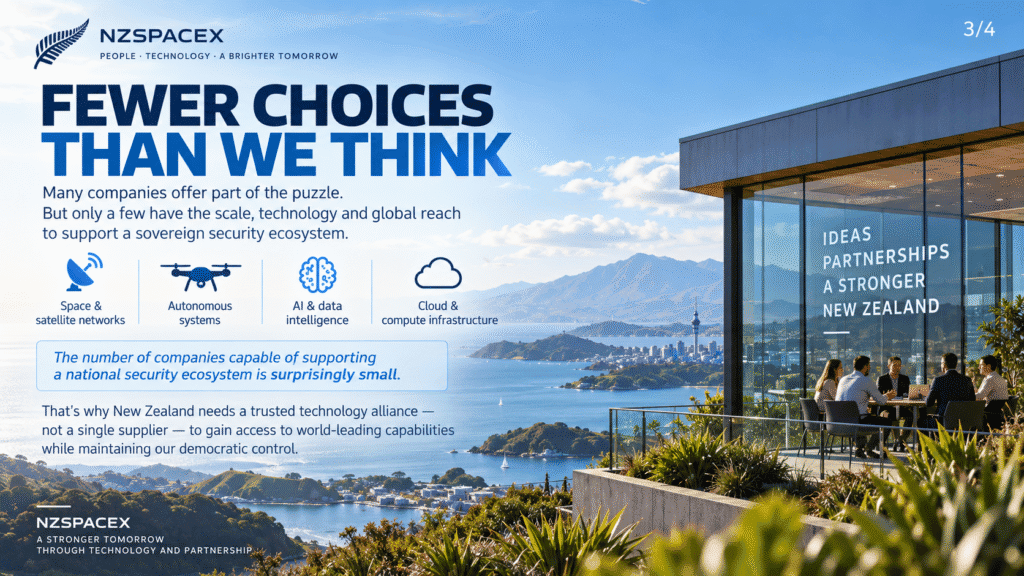
But very few organisations possess the scale, technology, capital and global reach required to contribute to an integrated national-security technology ecosystem.
One company may be strong in satellite communications.
Another may lead in autonomous systems.
Another may provide AI and data infrastructure.
Another may supply cloud computing, cyber security and large-scale processing.
This is why New Zealand should not look for a single corporate protector.
That would simply replace one vulnerability with another.
A more resilient model would be a trusted coalition of complementary technology partners.
For example, one partner might provide space and satellite infrastructure; another autonomy and robotics; another AI and data integration; another secure cloud and computing infrastructure.
The objective would not be dependency on one company.
It would be access to world-leading capability without creating a single point of sovereign failure.
Choose Partners Before You Need Protection
This is where the issue becomes uncomfortable, but important.
A small democratic country has roughly two broad options.
One is to attempt to develop every important capability itself.
That sounds maximally independent.
But it is expensive, slow and often unrealistic, especially when private technology companies and larger states are improving at a pace that government procurement systems cannot easily match.
The second option is to establish deep, structured and carefully regulated technology partnerships before they are urgently needed.
That is not necessarily a surrender of sovereignty.
It may be one of the ways sovereignty is preserved.
The dangerous condition is not simply having dependencies.
The dangerous condition is discovering, during a crisis, that you no longer have a choice about them.
Security Is Never Free
There is no free version of national security.
Building a complete domestic military-industrial system costs money.
Alliances carry obligations.
Technology partnerships require something in return.
So the question is not whether New Zealand will pay.
The question is:
What will we pay, and what exactly are we buying?
New Zealand has more to offer than cash.
We have geography.
A South Pacific location.
Deep-water infrastructure.
Energy.
Land.
Research institutions.
Political stability.
A credible legal system.
A developing space sector.
And the ability to provide long-term commercial certainty.
In return, carefully structured partnerships could provide access to capabilities such as satellite communications, advanced computing, AI infrastructure, cyber defence, space surveillance, autonomous systems, industrial support, training, maintenance and priority services during emergencies.
This is not about selling New Zealand.
It is about negotiating from a position of strength while we still have one.
The State Must Keep the Final Key
There must, however, be a hard boundary.
Technology can be contracted.
Infrastructure can be co-developed.
Communications, maintenance, surveillance, data processing and even certain defensive capabilities can involve commercial partners.
But the decision to use force cannot be outsourced.
War-making authority must remain with democratic government.
New Zealand territory cannot become private corporate territory.
A company’s leadership cannot become a substitute for constitutional authority.
And no democracy should depend on the personality of a particular CEO.
That is why the goal should not be to find a powerful individual and trust them.
The goal should be to create a Trusted Strategic Technology Partnership governed by law, contracts, transparency, democratic oversight, technical auditing, exit clauses, data sovereignty and multiple suppliers.
In other words:
Trust the system, not the personality.
The “Gentleman” Must Be a System, Not a Person
It is tempting to imagine that the solution is simply to find a benevolent and capable technology leader.
But people leave.
CEOs change.
Governments change.
Shareholders change.
Corporate priorities change.
The real “gentleman” in a modern strategic partnership therefore cannot be one individual.
It must be the structure around the relationship.
Clear rules.
Enforceable contracts.
Independent oversight.
Multiple providers.
New Zealand control over critical decisions.
The partnership should remain trustworthy even after every individual who originally signed it has gone.
New Zealand Still Needs Its Own Core Capability
None of this means abandoning our own defence capability.
New Zealand must continue to maintain the sovereign minimum required to protect national decision-making and basic security.
Domestic capability and strategic technology partnerships should not be treated as opposites.
They should serve different purposes.
The state keeps the sovereign core.
Technology partners provide speed, scale and access to capabilities that would be prohibitively expensive to reproduce independently.
That leads to a principle NZSPACEX has used elsewhere:
Targeted Capability, Not Full Replication.
Do not copy an entire ecosystem simply to prove independence.
Own what must remain sovereign.
Connect intelligently to what does not need to be recreated.
Keep Sovereignty. Buy Speed.
New Zealand does not need to become another United States.
We do not need a complete domestic military technology empire.
For a country of our size, a more rational strategy may be:
Keep sovereignty. Buy speed.
Keep decision-making authority. Access technology.
Keep democratic control. Use commercial innovation.
That is a very different concept from privatising defence.
It is about using private capability without privatising the state.
The Real Danger Is Not Dependency. It Is Losing Choice.
Small countries will always have dependencies.
Energy.
Aircraft.
Software.
Telecommunications.
Semiconductors.
Cloud computing.
Satellite infrastructure.
The mature response is not to pretend those dependencies do not exist.
It is to manage them.
They should be replaceable.
Auditable.
Diversified.
Contractually constrained.
And none should give one company or one foreign government an irreversible switch over New Zealand’s future.
Sovereignty in the AI era will increasingly depend on how intelligently countries manage these relationships.
Do Not Wait Until the High-Tech Pirates Arrive
The most dangerous future power may not resemble an old empire.
It could be a state with advanced autonomous systems.
It could be a heavily automated military-industrial network.
It could eventually even be an organisation with state-like technological capabilities: AI, satellites, autonomous fleets, cyber power and enormous industrial reach.
Small democracies cannot assume that every actor with such capabilities will share their values.
The worst possible strategy would be to prepare nothing, build no relationships, create no safeguards and simply wait to discover who dominates the next technological era.
At that point, choosing a protector may no longer be a negotiation.
It may become a necessity.
And necessity is expensive.
AI Changes the Price of Sovereignty
In the past, countries bought security primarily through armies.
In the future, they may also buy it through computing power, software, data, satellites, technology partnerships, strategic infrastructure and access to trusted commercial networks.
That does not make the state less important.
It makes intelligent statecraft more important.
From an NZSPACEX perspective, New Zealand should therefore begin discussing something broader than traditional procurement:
A Sovereign Technology Alliance
Not corporate rule.
Not a private army controlling New Zealand.
Not ports exchanged for protection.
But a structured alliance of trusted technology partners operating under New Zealand law, New Zealand democratic authority and clearly defined limits.
The state writes the rules.
Private industry supplies capability.
Law defines the boundary.
Multiple partners prevent monopoly dependency.
And New Zealand keeps the final decision.
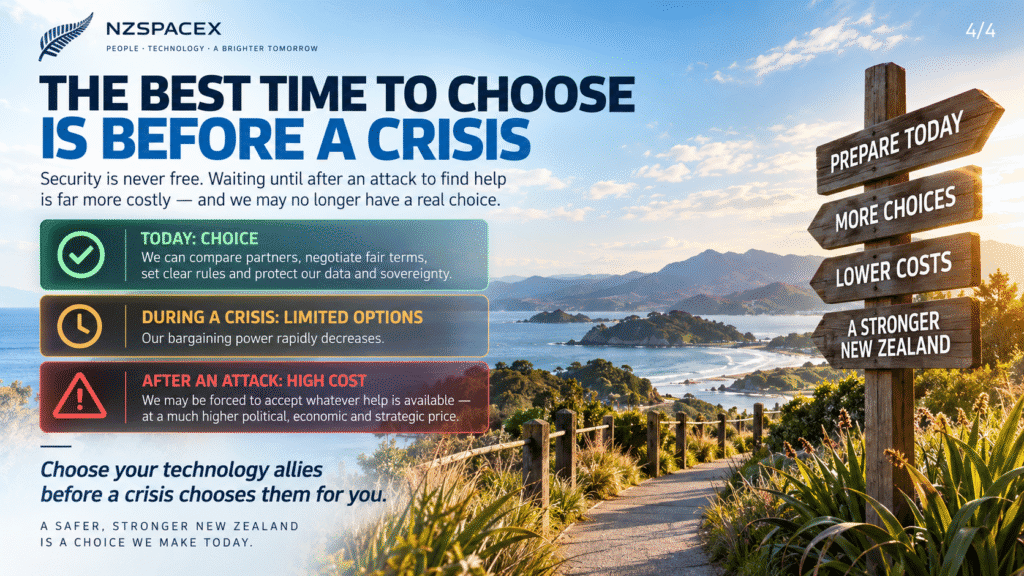
The Best Time to Choose Is Before a Crisis
This may be the most important point.
The expensive part is not choosing technology partners today.
The expensive part is waiting until communications are disrupted, critical infrastructure has been attacked, systems are failing and the country urgently needs satellite coverage, cyber defence, AI capacity or autonomous systems.
Only then asking:
Who can help us?
At that point, we are no longer negotiating from strength.
We are asking for rescue.
And those asking for rescue rarely receive the best terms.
Today, New Zealand can compare partners.
Negotiate prices.
Protect its data.
Set legal limits.
Require exit clauses.
Divide critical functions between multiple suppliers.
Decide what must always remain under sovereign control.
During a crisis, those choices narrow quickly.
After an attack, they may disappear entirely.
So the distinction is simple:
Choosing partners in advance is strategy.
Searching for protection after the crisis begins is cost.
If New Zealand will eventually depend on advanced technology ecosystems anyway, the sensible time to decide the price, rules and limits is while the country is safe, sovereign and still able to walk away from a bad deal.
Because the cost of choosing technology allies today is likely to be far lower than the cost of begging for help tomorrow.
AI CHANGES THE PRICE OF SOVEREIGNTY
Sovereignty is not becoming less valuable because of AI.
The way we preserve it is changing.
For a small democratic country like New Zealand, independence may no longer mean doing everything alone.
It may mean having enough foresight to choose the right partners while we still have the freedom to choose.
Choose your technology allies before a crisis chooses them for you.