
Lunar Helium-3 Is Not About Paying Earth Back
It May Be About Taking Humanity Farther Into Deep Space
For decades, helium-3 has occupied an unusual place in discussions about the Moon.
The story is compelling.
The lunar surface contains helium-3 implanted by billions of years of solar wind. Helium-3 can, in principle, be used in advanced fusion reactions. Its energy density is extraordinary. And because the Moon possesses quantities that are difficult to access naturally on Earth, it has often been described as one of the most valuable potential resources of a future lunar economy.
From there, the story usually takes a familiar turn:
Mine helium-3 on the Moon.
Bring it back to Earth.
Use it in fusion power stations.
Solve part of humanity’s energy problem.
That is where the economics begin to break down.
But it may also be where we have been asking the wrong question.
Helium-3 does not necessarily need to pay Earth back.
Its more important long-term role may be to support a civilisation moving outward — from Earth orbit, to the Moon, to Mars, and eventually to a much larger deep-space industrial system.
That distinction changes the entire discussion.
1. Start With Four Numbers
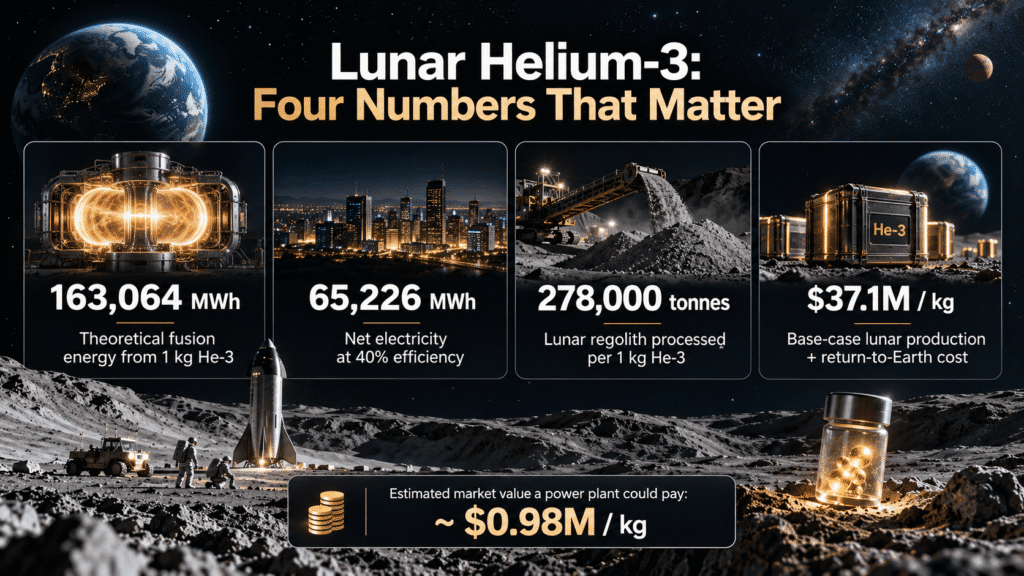
Before discussing fusion reactors, lunar mining or Starship, four numbers explain most of the problem.
For one kilogram of helium-3:
| Metric | Research model |
|---|---|
| Theoretical fusion energy | 163,064 MWh |
| Net electricity at 40% efficiency | 65,226 MWh |
| Lunar regolith processed | ~278,000 tonnes |
| Base-case lunar production + Earth return cost | ~US$37.1 million/kg |
At a modelled 40% net electricity efficiency, that becomes approximately:
65,226 MWh of electricity per kilogram of He-3.
That sounds spectacular.
And physically, it is.
The problem appears when we connect the front end of the supply chain to the back end.
2. Helium-3 Really Is an Extraordinary Fuel
The deuterium–helium-3 fusion reaction is often described as one of the most attractive advanced fusion pathways:
D + He-3 → He-4 + proton + energy
Its principal products are charged particles rather than the dominant high-energy neutron output associated with deuterium-tritium fusion.
That offers theoretical advantages.
Charged fusion products create the possibility of advanced direct-energy conversion. Lower neutron loading could potentially reduce some material damage and activation challenges. And the fuel itself has extraordinary energy density.
But D-He3 fusion is also much harder than D-T fusion.
So helium-3 is not magic.
It is a potentially remarkable fuel for a very advanced technological civilisation.
That difference matters.
3. The First Economic Mistake: Energy Value Is Not Fuel Value
A common helium-3 argument starts with a simple multiplication:
One kilogram can generate an enormous amount of electricity, therefore one kilogram must be worth an enormous amount of money.
That is incomplete.
A power station cannot hand all of its electricity revenue to the fuel supplier.
It must first pay for:
- reactor construction;
- financing;
- superconducting magnets;
- plasma heating systems;
- cryogenics;
- vacuum systems;
- cooling;
- power conversion;
- first-wall and divertor replacement;
- maintenance;
- staff;
- decommissioning;
- and the station’s own internal power consumption.
So the better question is:
How much money remains for the fuel after the power station itself has been paid for?
Using the research model’s base case:
- electricity value: US$75/MWh
- non-fuel fusion cost: US$60/MWh
- available fuel margin: US$15/MWh
- net electricity per kg He-3: 65,226 MWh
Therefore:
Maximum fuel value ≈ US$978,000/kg
or roughly:
US$0.98 million per kilogram.
The model therefore places a very large gap between what an Earth electricity market could support and what lunar production might cost.
4. The Lunar Mining Problem Is Hidden by the Final Payload
Helium-3 appears to be an ideal space commodity because the final product is so light.
One kilogram is one kilogram.
Even a hundred kilograms would be a relatively modest return payload.
But this creates a dangerous illusion.
The hard part is not returning the kilogram.
The hard part is producing it.
The research model uses a representative mature lunar-mare helium-3 concentration of around 6 ppb, combined with an assumed total recovery of approximately 60%.
At those values, producing one kilogram of He-3 requires processing roughly:
278,000 tonnes of lunar regolith.
That is the number that changes the discussion.
The Moon does not offer helium-3 as concentrated underground reservoirs waiting to be pumped.
It is diffusely implanted into lunar regolith.
So a helium-3 industry requires an enormous front-end materials operation.
5. One Kilogram of He-3 Implies an Industrial Chain
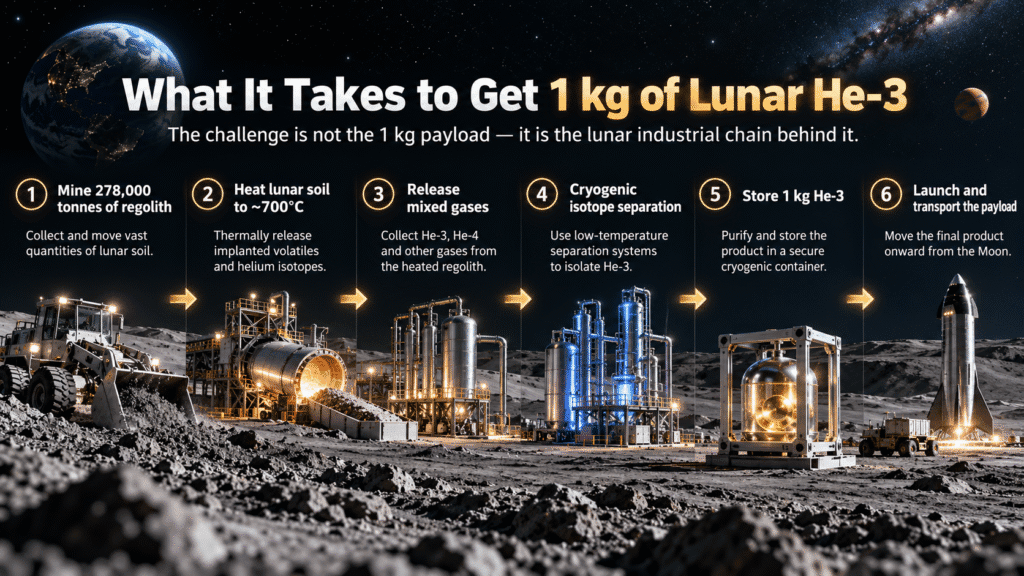
To produce that kilogram, a lunar system may need to:
- excavate huge quantities of regolith;
- transport and feed that material;
- heat it to hundreds of degrees Celsius;
- release implanted gases;
- capture mixed volatiles;
- separate helium from other gases;
- separate He-3 from He-4;
- purify the product;
- store it cryogenically;
- move it to a launch point;
- launch it from the Moon;
- transfer it onward.
That means lunar helium-3 mining is not simply a mining problem.
It is the combination of:
mine + thermal plant + gas-processing plant + isotope plant + power station + maintenance base + spaceport.
This is the real industrial challenge.
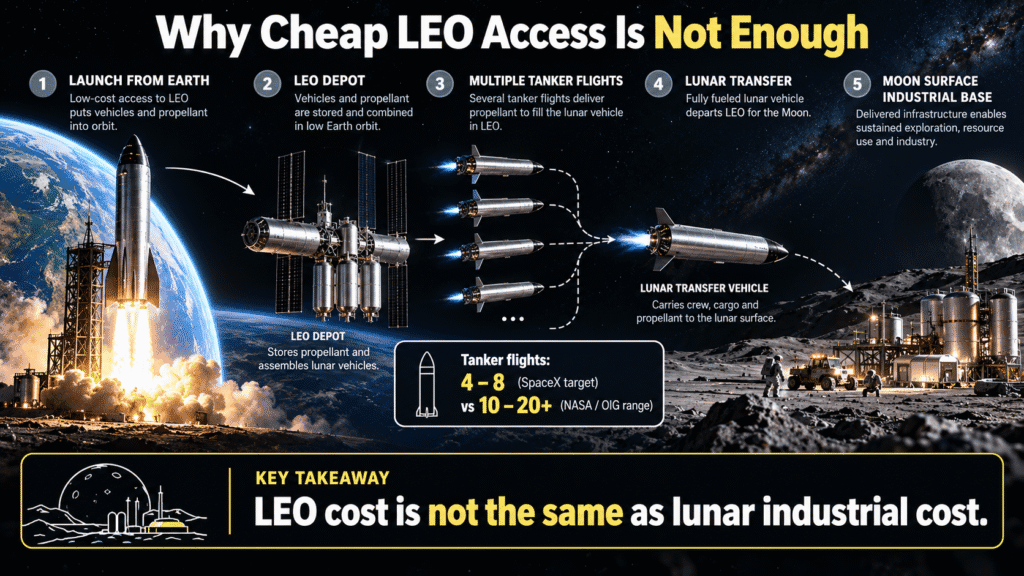
6. Cheap Launch to LEO Does Not Automatically Mean Cheap Lunar Industry
This is where Starship enters the argument.
If Starship succeeds at dramatically reducing launch costs, it could transform the economics of space activity.
But a low cost to Low Earth Orbit is not the same thing as a low cost to operate an industrial complex on the Moon.
A lunar logistics chain may involve:
Earth launch
→ Low Earth Orbit
→ orbital propellant storage
→ tanker launches
→ cryogenic propellant transfer
→ lunar transfer
→ lunar landing
→ surface transport
→ maintenance and replacement
Different estimates for a lunar refuelling campaign vary considerably.
The research compilation records:
- 4–8 tanker flights in optimistic SpaceX-oriented assumptions;
- roughly 10–14 in some NASA HLS planning assumptions;
The precise number can change as the vehicle evolves.
The important point is structural:
A cheap ride to LEO is only the first layer of a lunar industrial economy.
7. If We Judge He-3 Only as an Earth Electricity Commodity, the Numbers Look Poor
Under the research model, the economic comparison is severe.
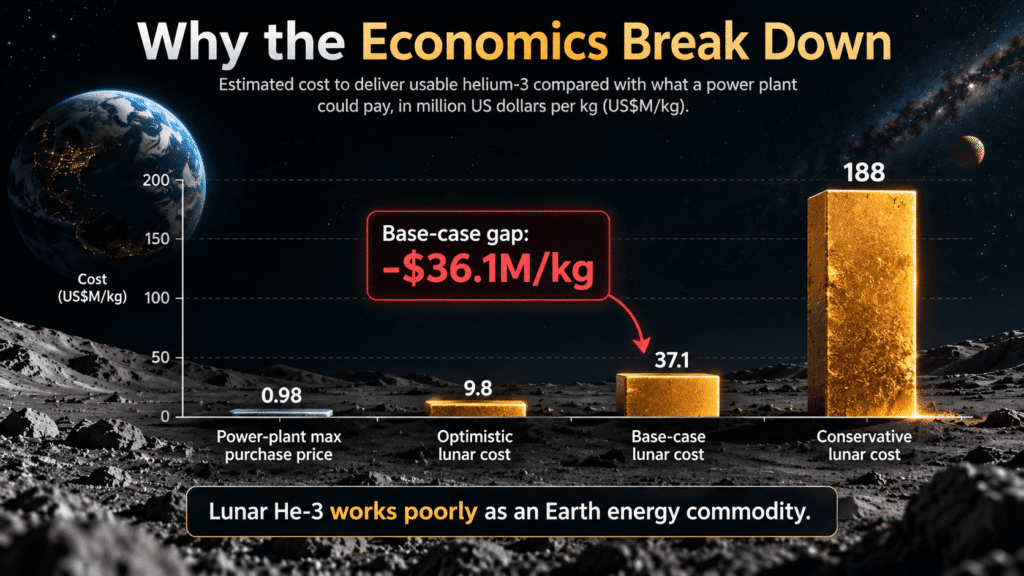
| Scenario | Approx. He-3 cost |
|---|---|
| Earth power-station maximum fuel value | US$0.98M/kg |
| Optimistic lunar production case | US$9.8M/kg |
| Base case | US$37.1M/kg |
| Conservative case | US$188M/kg |
The base-case difference is approximately:
US$36.1 million per kilogram.
That is not a normal optimisation gap.
It is not a matter of shaving 10% from launch cost.
To close a gap of this size, multiple parts of the system would need to improve simultaneously:
- mining productivity;
- ore grade;
- equipment lifespan;
- thermal efficiency;
- isotope separation;
- power supply;
- lunar logistics;
- vehicle reusability;
- financing;
- and fusion-reactor economics.
This is why the idea of mining lunar helium-3 primarily to ship it back to Earth as a bulk electricity fuel is difficult to support under the model.
But that is not the end of the helium-3 story.
It may only be the end of the wrong story.
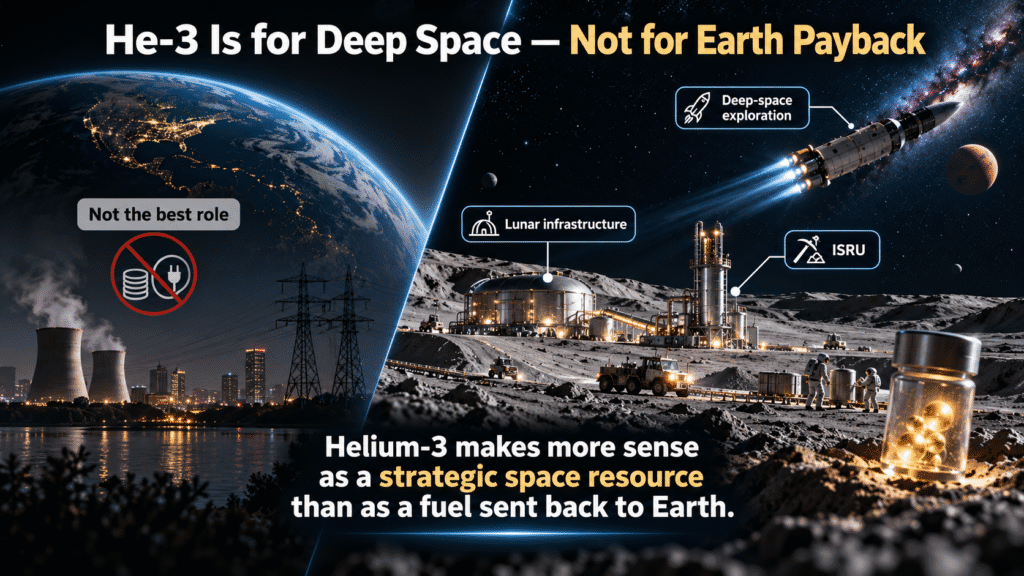
8. Helium-3 May Not Be for Earth Payback
The deeper question is not:
Can helium-3 compete with terrestrial electricity?
The deeper question may be:
What energy resources will a future deep-space civilisation need once it is operating far beyond Earth?
This changes the economic frame completely.
A kilogram of fuel on the Moon does not have the same strategic value as a kilogram delivered to a power station on Earth.
Location matters.
Infrastructure matters.
Mission architecture matters.
Energy density matters far more when every kilogram must be accelerated, transported and supported across millions of kilometres.
In that environment, helium-3 could eventually be valued not because it undercuts a terrestrial power station, but because it could support energy or propulsion systems in places where terrestrial alternatives become difficult, heavy or logistically expensive.
That is a fundamentally different economic role.
9. Earth Is Not Necessarily the Customer
A mature lunar economy could use resources locally.
This is the central logic of in-situ resource utilisation — ISRU.
If resources can be extracted and used on or near the Moon, they do not need to climb out of Earth’s deep gravity well first.
Water ice could become oxygen, hydrogen, shielding or propellant.
Metals could support construction.
Lunar materials could support infrastructure.
And in a much more technologically advanced future, helium-3 could potentially become part of an off-Earth high-energy system.
The customer may therefore not be:
an electricity company in New Zealand, China, Europe or the United States.
The customer may instead be:
- a lunar industrial settlement;
- a deep-space transport system;
- an orbital power facility;
- a Mars cargo architecture;
- a scientific outpost;
- or technologies that do not yet exist.
This is why judging helium-3 only by its return-to-Earth price may miss the larger strategic question.
10. He-3 Makes More Sense After Lunar Industry Exists
There is an important order of operations.
Humanity should probably not build a massive lunar industrial system because helium-3 alone pays for it.
The economics do not support that conclusion today.
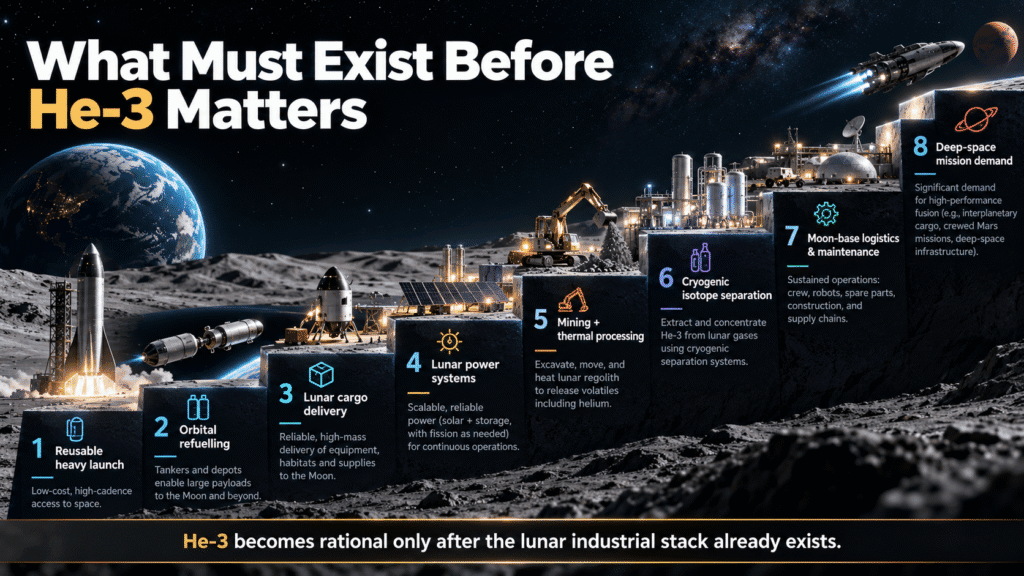
Instead, a larger lunar industrial stack would likely have to emerge first.
For example:
- reusable heavy launch;
- orbital refuelling;
- reliable lunar cargo delivery;
- surface power;
- robotic mining;
- thermal processing;
- gas separation;
- maintenance and replacement;
- local construction;
- sustained deep-space mission demand.
Only then does helium-3 become easier to interpret economically.
At that stage, helium-3 may no longer have to carry the full cost of building the Moon’s infrastructure.
It may be collected as part of a wider resource-processing industry.
That is a much stronger proposition.
11. In That Future, He-3 Could Be a By-product Rather Than the Reason for Going
Imagine a future lunar industrial operation already processing millions of tonnes of regolith for other reasons.
It may be extracting:
- oxygen;
- metals;
- water;
- hydrogen-bearing compounds;
- solar-wind volatiles;
- construction material.
The thermal-processing infrastructure already exists.
The power system already exists.
The transport system already exists.
The maintenance workforce already exists.
Then helium-bearing gases produced during processing are no longer carrying the full capital burden of the entire lunar settlement.
He-3 becomes one stream in a much larger industrial process.
That changes the economics dramatically.
It may still be rare.
It may still be expensive.
But it no longer has to justify the Moon.
12. This Is Why Starship Matters Even If Lunar He-3 Does Not Pay
A weak argument for Starship would be:
Starship matters because it will make helium-3 profitable.
That is far too narrow.
Starship’s significance is potentially much larger.
If SpaceX can ultimately deliver:
- reusable heavy lift;
- high launch cadence;
- reliable orbital insertion;
- large payload volume;
- orbital refuelling;
- lunar cargo delivery;
- deep-space logistics;
- and low refurbishment costs;
then Starship begins to function less like a single rocket and more like transportation infrastructure.
The research material correctly separates several different meanings of success:
- engineering success;
- orbital success;
- recovery success;
- reuse success;
- economic reuse.
The Space Shuttle proved that a spacecraft can be reusable without necessarily being economically reusable.
Starship is attempting to solve the next problem.
13. SpaceX Has Already Changed the Question
This may ultimately be one of Elon Musk and SpaceX’s most important contributions.
They have repeatedly taken assumptions that were treated as permanent constraints and turned them back into engineering questions.
Must a booster be discarded?
No.
Must a first stage land using large fixed infrastructure on the vehicle?
Not necessarily.
Can very large launch vehicles be manufactured at high cadence?
Can an upper stage also be recovered?
Can propellant be transferred in orbit at scale?
Can launch economics approach a transportation model rather than a traditional aerospace procurement model?
Some of those questions have already been partly answered.
Others remain open.
That is precisely why the programme remains important.
It is attacking the infrastructure problem.
14. Deep-Space Exploration Cannot Be Judged Only by Immediate Profit
Cost discipline matters.
It matters enormously.
Without realistic cost accounting, space development can easily turn into mythology.
But the opposite mistake is also possible.
If humanity demands that every major piece of exploration infrastructure generate immediate financial returns, then many foundational capabilities would never be built.
Ports do not exist for one cargo.
Railways do not exist for one mineral.
The internet was not built for one website.
A deep-space transport network should be judged partly in the same way.
Its value may emerge from the range of activities it makes possible.
Those activities could include:
- astronomy;
- planetary science;
- manufacturing;
- communications;
- robotics;
- mining;
- orbital construction;
- energy systems;
- planetary defence;
- human settlement;
- and industries that have not yet been invented.
So it is perfectly consistent to say:
Lunar helium-3 is not presently convincing as an independent Earth-energy mining business.
while also saying:
Building the capability to operate economically on the Moon and beyond may still be one of the most important industrial projects of this century.
Those statements do not conflict.
15. He-3 May Be Fuel for the Journey, Not a Refund for Earth
That may be the most useful way to think about helium-3.
Not as a cheque written by the Moon to repay Earth.
Not as a magical commodity that automatically makes lunar mining profitable.
Not as proof that humanity must colonise the Moon.
Instead:
as a potential strategic resource inside a future deep-space economy.
If advanced fusion eventually becomes practical, energy-dense fuels located outside Earth’s gravity well could acquire a value that cannot be captured by today’s electricity-price calculations.
Their value may depend on what they enable:
- longer missions;
- heavier cargo;
- faster interplanetary transport;
- greater autonomy;
- large-scale space industry;
- or human operations farther from Earth.
That future remains technologically uncertain.
But it is a more coherent long-term reason to study helium-3 than the idea of digging up lunar soil merely to compete with terrestrial power stations.
Conclusion: The Moon Does Not Need to Pay Us Back
The most important lesson from lunar helium-3 is not that the idea is a fraud.
Nor is it that helium-3 will necessarily transform civilisation.
The lesson is subtler.
Physics is real.
Energy density is real.
Industrial difficulty is real.
Economics is real.
And the strategic value of a resource depends strongly on where, when and how it is used.
Today, sending lunar helium-3 back to Earth for electricity looks economically unattractive under the model examined here.
Tomorrow, the same resource could have a very different value inside an established lunar and deep-space industrial system.
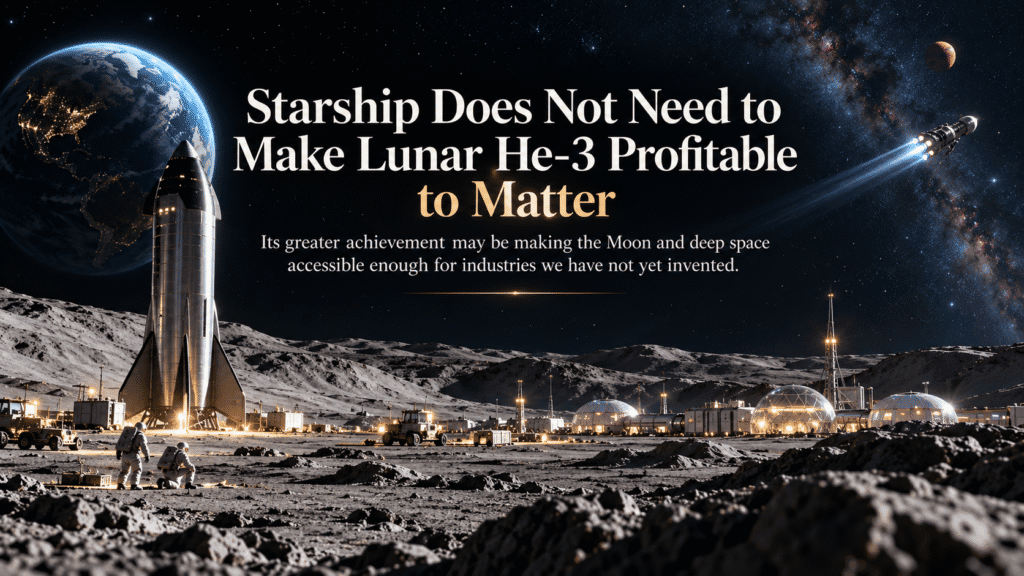
That is why Starship does not need to make lunar helium-3 profitable in order to matter.
Its greater achievement may be something much larger:
Making the Moon, and eventually deep space, accessible enough for industries and missions that humanity has not yet invented.
Perhaps helium-3 is not the reason we build the road.
Perhaps it is one of the resources we discover how to use after the road already exists.
FAQ
Is helium-3 really present on the Moon?
Yes. Helium-3 has been detected in lunar regolith, where solar-wind particles have been implanted over geological time. The challenge is that concentrations are extremely low.
How much lunar soil is needed for 1 kg of helium-3?
Under the base research assumptions used in this article, roughly 278,000 tonnes of lunar regolith would need to be processed to recover one kilogram of helium-3.
Can helium-3 power Earth?
In principle, D-He3 fusion contains enormous energy. But commercial D-He3 fusion does not yet exist, and lunar mining and return costs currently appear far above what terrestrial electricity markets could support.
Why is Starship important to lunar helium-3?
Starship could reduce the cost of moving large amounts of equipment and propellant into space. However, sustainable lunar industry also requires orbital refuelling, power, mining, processing, maintenance and surface logistics.
Could helium-3 be useful in deep space instead?
Potentially. If advanced fusion becomes practical, helium-3 produced within an established lunar industrial economy might have greater strategic value for off-Earth energy or propulsion than as a