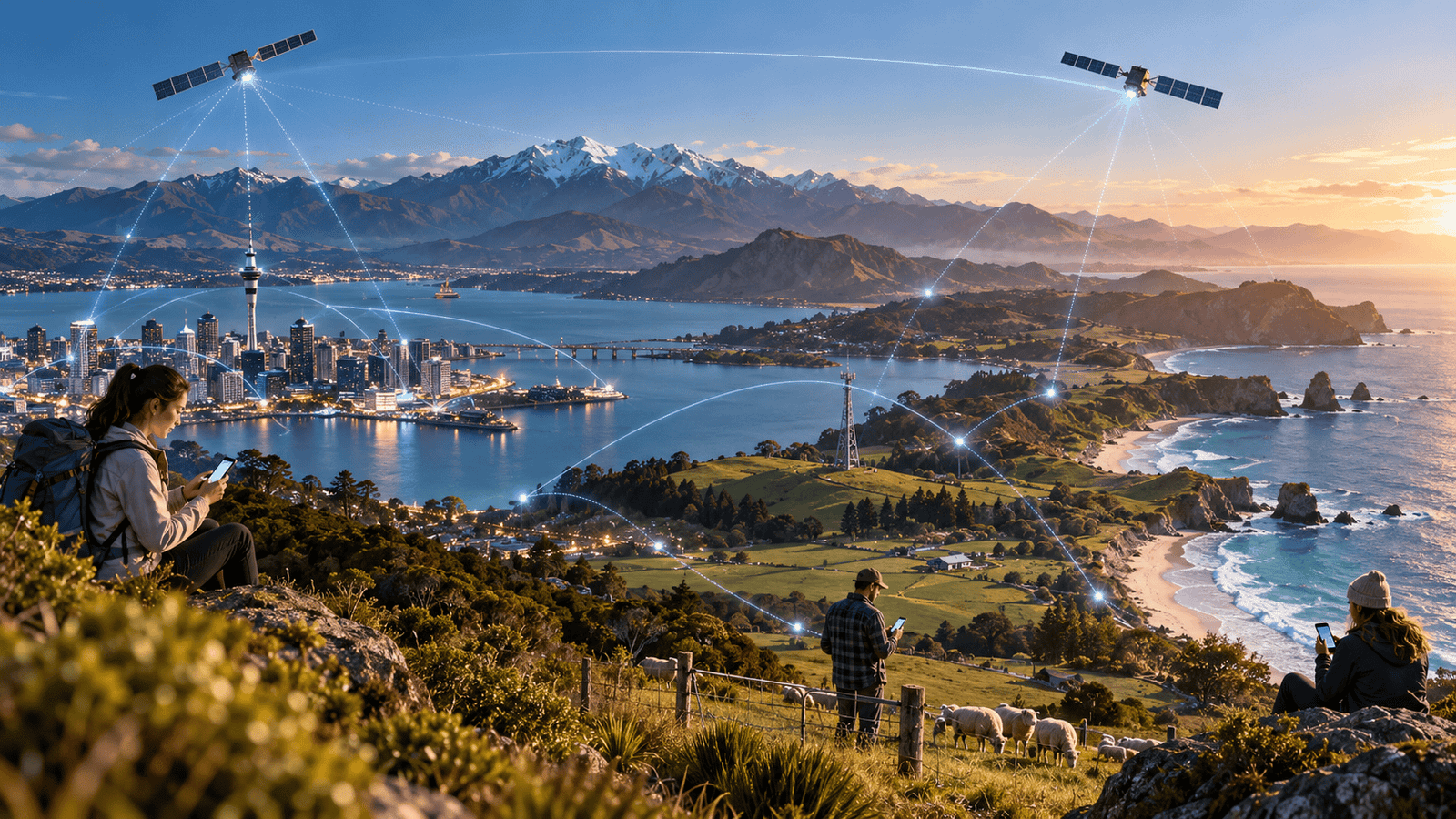
Starlink is moving beyond satellite broadband. SpaceX’s latest spectrum deal suggests that it increasingly sees itself as a future mobile-network operator as well.
SpaceX has agreed to acquire up to 14 MHz of paired low-band spectrum in the 800 MHz range from Grain Management for approximately US$8 billion, subject to regulatory approval. Reuters reports that the spectrum is intended to support Starlink Mobile and could eventually be combined with terrestrial infrastructure in a hybrid satellite-and-ground network.
Reuters background on the 800 MHz spectrum acquisition
For New Zealand, this matters because satellite-to-mobile is not theoretical. One NZ already uses Starlink Direct to Cell technology to extend mobile connectivity beyond terrestrial cell-tower coverage. One NZ says its satellite service uses standard 4G/LTE technology and supports messaging and selected data applications on eligible devices where users have line of sight to the sky.
One NZ Satellite technical information
Low-band spectrum changes the mobile question
Low-band spectrum is valuable because it travels over long distances and generally penetrates buildings better than higher-frequency mobile spectrum. It does not provide unlimited capacity, but it is extremely useful for broad-area coverage.
The long-term question is no longer simply whether Starlink can send emergency messages to a phone. It is whether a satellite constellation can gradually become another layer of the cellular network itself.
New Zealand is an unusually good test market
New Zealand has a dispersed population, mountainous terrain, long coastlines, remote farms, forestry, marine users and large areas where building dense terrestrial tower infrastructure is expensive.
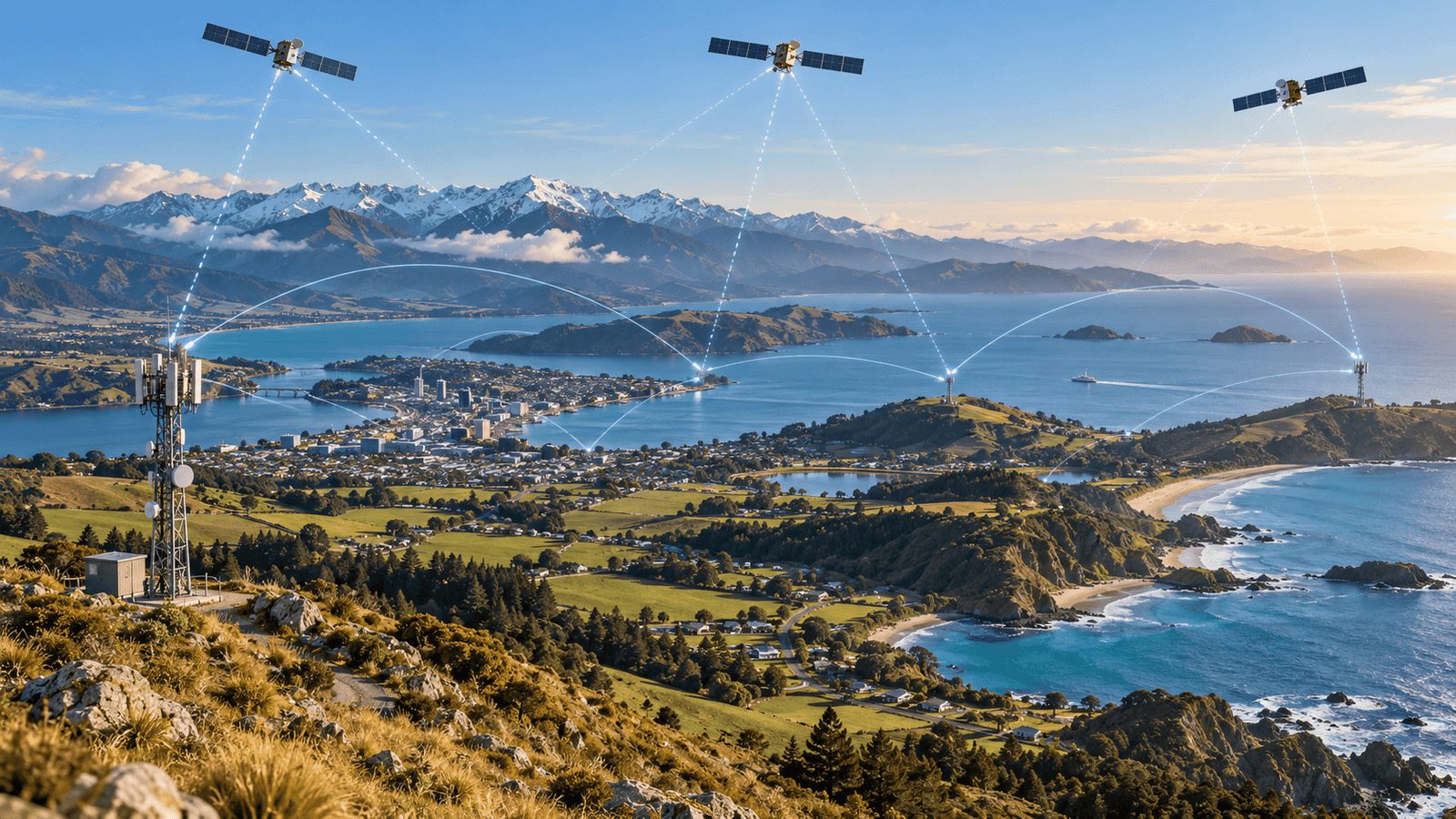
One NZ already demonstrates one possible hybrid model: terrestrial towers where they work best, satellite coverage where towers do not reach.
Terrestrial towers where they work best, satellite coverage where towers do not reach.
Early demand may come from users who value coverage more than price
NZSPACEX expects the strongest early commercial appeal of more capable satellite mobile service to come from customers for whom coverage and resilience matter more than the cheapest possible monthly plan.
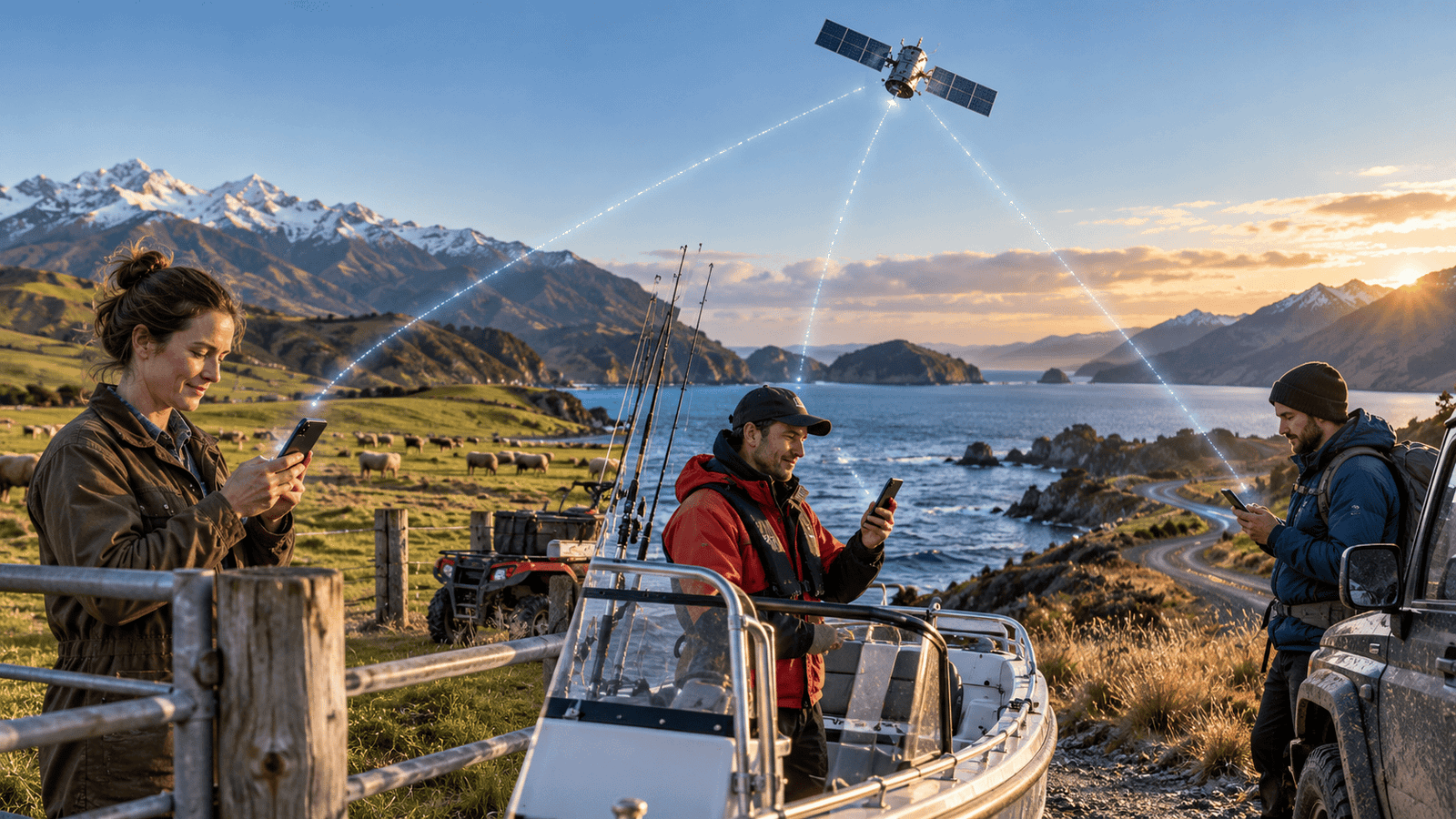
That could include rural businesses, farmers, forestry, transport operators, marine users, construction teams, emergency services, travellers and remote workers.
For these customers, the question is not whether satellite mobile is cheaper than urban 5G. The question is whether the phone works when the nearest conventional tower does not.
Cooperation may come before competition
New Zealand already demonstrates one possible business model: Starlink provides the satellite layer while an established terrestrial operator integrates it into its existing mobile service.
That cooperative structure makes sense in the near term. Existing operators already have customers, billing systems, spectrum, retail support and dense urban infrastructure. SpaceX provides coverage from above where the terrestrial network becomes uneconomic or unavailable.
But the US spectrum acquisition creates another possibility. If SpaceX owns enough suitable spectrum and develops the necessary infrastructure, it may eventually have more freedom to operate as a mobile provider rather than only as a wholesale satellite partner.
That does not mean Starlink will replace conventional networks. Dense cities still demand huge capacity, low latency, indoor coverage and extensive terrestrial infrastructure.
But traditional operators can no longer assume that lack of cell towers automatically protects their market.
The barrier is becoming commercial and regulatory, not purely technical
Direct-to-device satellite communication is already real. The remaining challenges increasingly concern spectrum rights, network capacity, handset compatibility, regulatory approvals, economics and integration with terrestrial systems.
SpaceX’s willingness to spend billions of dollars on spectrum is significant because it demonstrates that the company sees mobile connectivity as a major future market rather than a small emergency-service add-on.
If satellite mobile can deliver useful coverage to ordinary handsets, the competitive boundary between a satellite company and a mobile operator begins to disappear.
Satellite will not be perfect — but weather is not the main problem
Low-frequency direct-to-device links are less vulnerable to ordinary cloud and rain than high-frequency satellite broadband links. The more important limitations are line of sight to the sky, buildings and terrain, handset transmit power, satellite capacity, spectrum reuse and simultaneous-user load.
This is why hybrid networks are likely to remain important. Terrestrial towers can supply enormous capacity in cities, while satellites can close geographic gaps.
What happens to the traditional mobile operator?
The most likely near-term future is cooperation. But cooperation only works while both sides see value in it.
If incumbent operators rely too heavily on infrastructure or regulatory barriers rather than service quality and coverage, satellite-mobile competition may become more direct. Large satellite operators may have the scale to pursue more independent models in selected markets.
Technological progress is difficult to stop through market barriers alone.
New Zealand should watch Starlink Mobile closely
New Zealand was already one of the earliest markets to experience commercial satellite-to-phone service at national scale.
The 800 MHz acquisition suggests that the next stage may be larger than emergency connectivity.
The question is how quickly satellite connectivity becomes an ordinary part of the phone already in our pockets — and whether today’s mobile operators remain partners, become competitors, or eventually become both.